
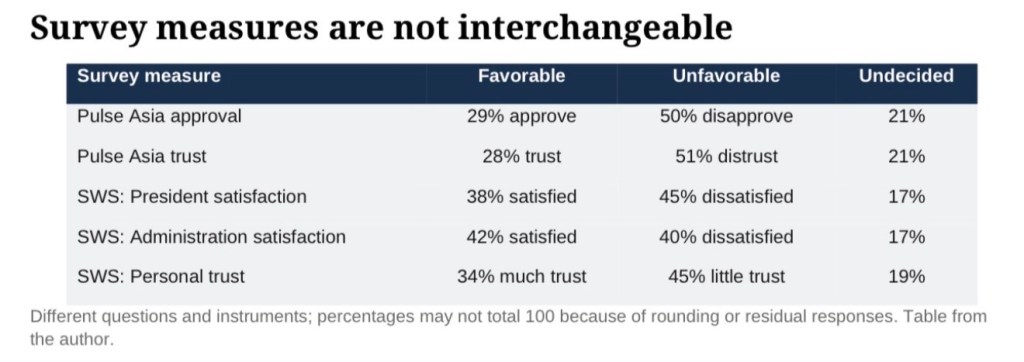
SOCIAL Weather Stations’ (SWS) June survey produced what looks like a contradiction inside a single set of interviews. President Ferdinand Marcos Jr.’s personal net satisfaction rating improved by 8 points from -15 in March to -7. His administration’s net satisfaction rose 14 points from -13 to +1. Yet, his personal net trust fell from -3 to -11.
The temptation is to ask which number is correct. That is the wrong question. SWS measured satisfaction and trust from June 20 to 29. Pulse Asia measured approval and trust from June 28 to July 3 and 6. The fieldwork overlapped, but the samples, wording, response categories and reported scales were different.
Read properly, the surveys are not contradictory. Together, they describe a presidency that may have stopped falling in one measure, but remained politically fragile in another.
Recovery — but not recovery to strength
SWS recorded improvement in Marcos’ personal satisfaction rating in every major area. Balance Luzon rose from +2 in March to +11 in June; the Visayas, from -15 to -3;
Metro Manila, from -31 to -24; and Mindanao, from -40 to -35. The administration’s net satisfaction also improved across all four areas, reaching +13 in Balance Luzon, +5 in the Visayas, -11 in Metro Manila, and -17 in Mindanao.
But improvement from very weak levels is not the same as restored political strength.
Forty-five percent remained dissatisfied with Marcos personally, against 38 percent satisfied. The administration did slightly better: 42 percent satisfied against 40 percent
What the surveys establish — and what they do not The evidence supports two conclusions. Marcos remained politically weak nationally, while satisfaction with him and his administration improved between March and June.
These are not mutually exclusive statements. A rebound describes movement from a previous point; it does not establish that the new level is strong or that trust has returned.
The surveys cannot establish why every respondent changed position. Their fieldwork coincided with impeachment preparations, corruption allegations, arrests, economic concerns and a major earthquake in southern Mindanao. The data cannot separate those effects.
Nor do the results predict the 2028 election. Approval is not voting intention. Trust is not a ballot. Satisfaction can recover or deteriorate as conditions, alliances and political events change. The disciplined use of surveys is to track direction and depth without pretending that a current rating is destiny.
The easiest headline is that one poll showed improvement while another showed decline. The more accurate reading is that satisfaction recovered from a record low, including a narrow positive turn for the administration, but confidence in Marcos remained weak. The apparent contradiction disappears once the questions are read as they were actually asked.


Leave a Reply