
Originally published in The Manila Times on September 2, 2026.
THIS is an attempt to dissect Bam Aquino’s extraordinary rise in the 2025 midterm elections using numbers rather than political narrative. The Aquino name, the “Pink” vote, the youth, social media, endorsements and campaign strategy have all been offered as explanations. Some may be correct. Instead of beginning with any of them, we begin with the surveys and election returns and ask where the numbers lead.
Three weeks before the 2025 polls, Aquino still looked like a candidate fighting for the last Senate seats. Pulse Asia’s April 20–24 survey put him at 25.4 percent, with a statistical ranking of 11th to 18th. On Election Day, he finished second nationwide with 20,971,899 votes.
The distance between those snapshots is the story. Calling it simply a late surge describes the timing; the more useful question is what kind of movement it was and what the ballot tells us about how it happened.
The surge kept moving after the final poll
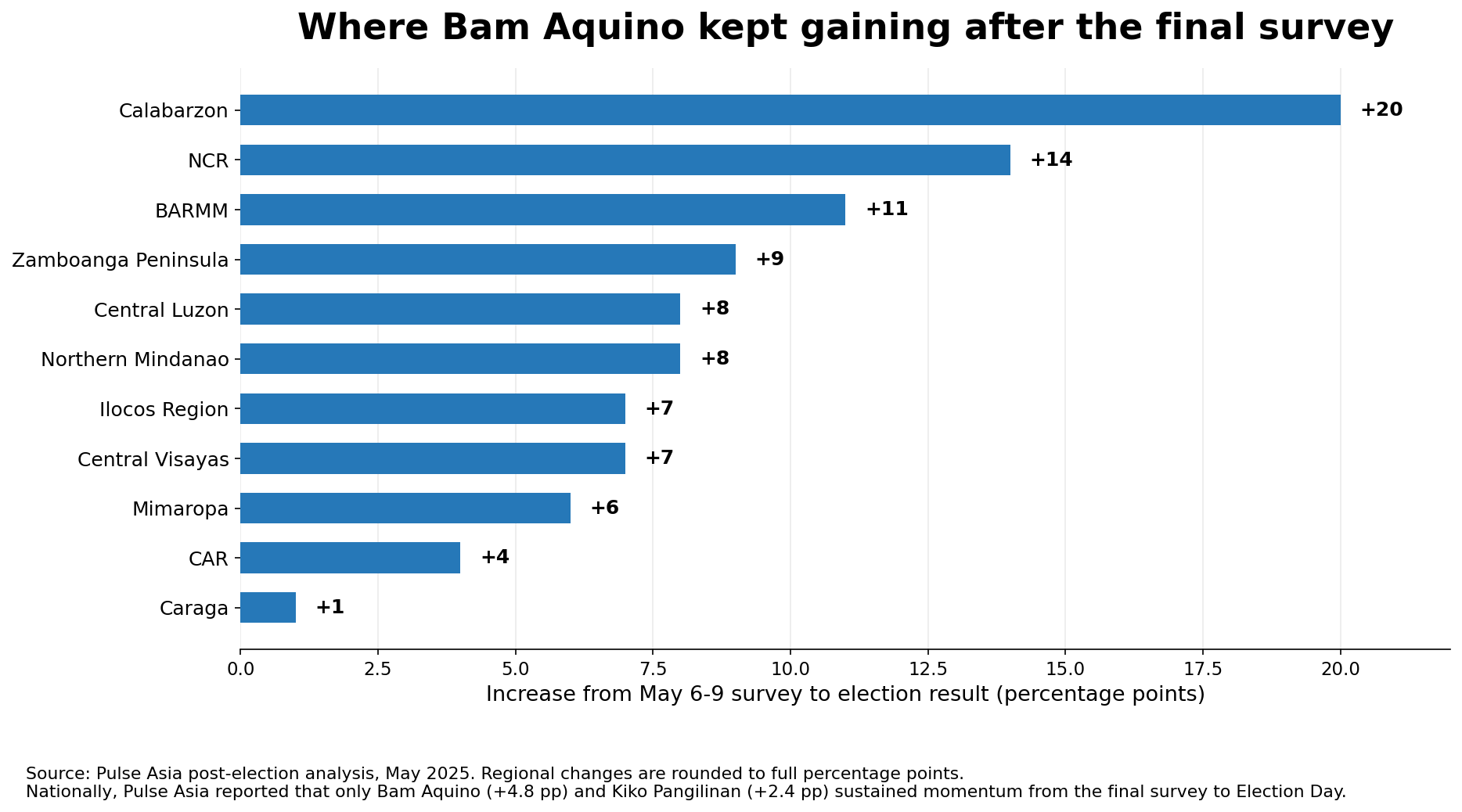
Pulse Asia’s post-election comparison shows that the surge was still moving after its final poll. Aquino gained 7.4 percentage points from the April survey to the May 6–9 fieldwork, then another 4.8 points on Pulse Asia’s comparable vote-share measure by Election Day. Only Aquino and Kiko Pangilinan, who gained another 2.4 points, sustained positive national momentum through the vote.
The geography is even more revealing. Pulse Asia recorded gains for Aquino in 11 regions, led by Calabarzon (+20), NCR (+14), BARMM (+11) and Zamboanga Peninsula (+9), with further gains across Luzon, the Visayas and Mindanao. This was not a single opposition geography. His support was still expanding in very different political territories during the final days.
The first clue is the shape of the Senate ballot itself.
In February, Pulse Asia found voters naming a mean of eight Senate candidates; in March, nine; and by April, eight again. Only 27 percent of registered voters had filled all 12 slots. Most voters still had room on their ballots.
That matters because a Senate candidate does not have to become a voter’s favorite. He only has to become acceptable enough to occupy one of as many as 12 slots. Aquino could be added without requiring voters to abandon their first political loyalties. His name recognition and a clear campaign identity made that easier: a voter could add him late without first removing a candidate already tied to a preferred political camp.
The final Pulse Asia fieldwork, conducted May 6–9 and released after the election, caught part of the movement at 32.8 percent. Using Comelec’s final 20,971,899 votes and turnout of 57,350,968, roughly 36.6 percent of participating voters placed Aquino on their Senate ballot.
Where the crossover becomes visible
The national total is only half the story. The more revealing evidence is geographic.
Strong performance in Western Visayas or other areas associated with the Aquino, Roxas and Robredo tradition should not automatically be called crossover. Those places show that a friendly base turned out. The more interesting test is territory that was not naturally his.
In Pangasinan, Aquino ranked first with 755,099 votes. He also ranked first in Cavite with 926,675. In Leyte, he finished third behind Bong Go and Bato dela Rosa; in Cebu province, where the two Duterte-aligned senators dominated, he still placed sixth with nearly 900,000 votes. In South Cotabato, he made the top eight, and in Koronadal City, he was fourth.
Those results do not prove that individual Duterte or Marcos voters switched allegiance. They show something we can observe: electorates supporting candidates from very different camps were also making room for Bam Aquino. That distinction matters. Aggregate returns cannot identify individual switchers, but they can show when a candidate travels beyond the geography expected of his original base.
The Senate’s “second-choice” advantage
A presidential candidate must become the voter’s single choice. A Senate candidate can prosper as a voter’s sixth, eighth or tenth choice. Aquino’s 2025 campaign appears to have converted broad acceptability into ballot occupancy while millions of voters were still completing their lists.
That helps explain why earlier surveys could understate his eventual performance. The May 6–9 Pulse Asia survey had already begun to detect the movement; Election Day carried it farther. The surprise was not necessarily that the polls were wrong, but that consequential movement happened very late in a race where voters still had unused slots.
What No. 2 proved—and what it did not
Aquino’s second-place finish showed that his 2025 electoral market was much larger than the traditional opposition base. It demonstrated national reach, cross-camp acceptability and an ability to gain late as voters made final ballot decisions.
It did not prove that 36.6 percent of voters would choose him for president. A Senate ballot reveals whom voters are willing to include. The 2028 race will test something harder: whom they are willing to choose above everyone else.
Bong Habana Ruado is a former public-sector official whose career has spanned government, politics, public policy and the private sector. His current interests include public opinion research, governance data and explanatory journalism, with a particular focus on interpreting political surveys beyond their headline numbers. He holds degrees in political science and law (Juris Doctor) and completed the Strategic Business Economics Program at the University of Asia and the Pacific.


Leave a Reply